Grok Voice Transcribe 2.0: Telephony Architecture & Benchmarks
// Dossier Executive Lead
Architectural analysis of xAI Grok Voice Transcribe 2.0: 2x telephony accuracy, 8-channel diarization, and $0.10/hr enterprise speech economics.
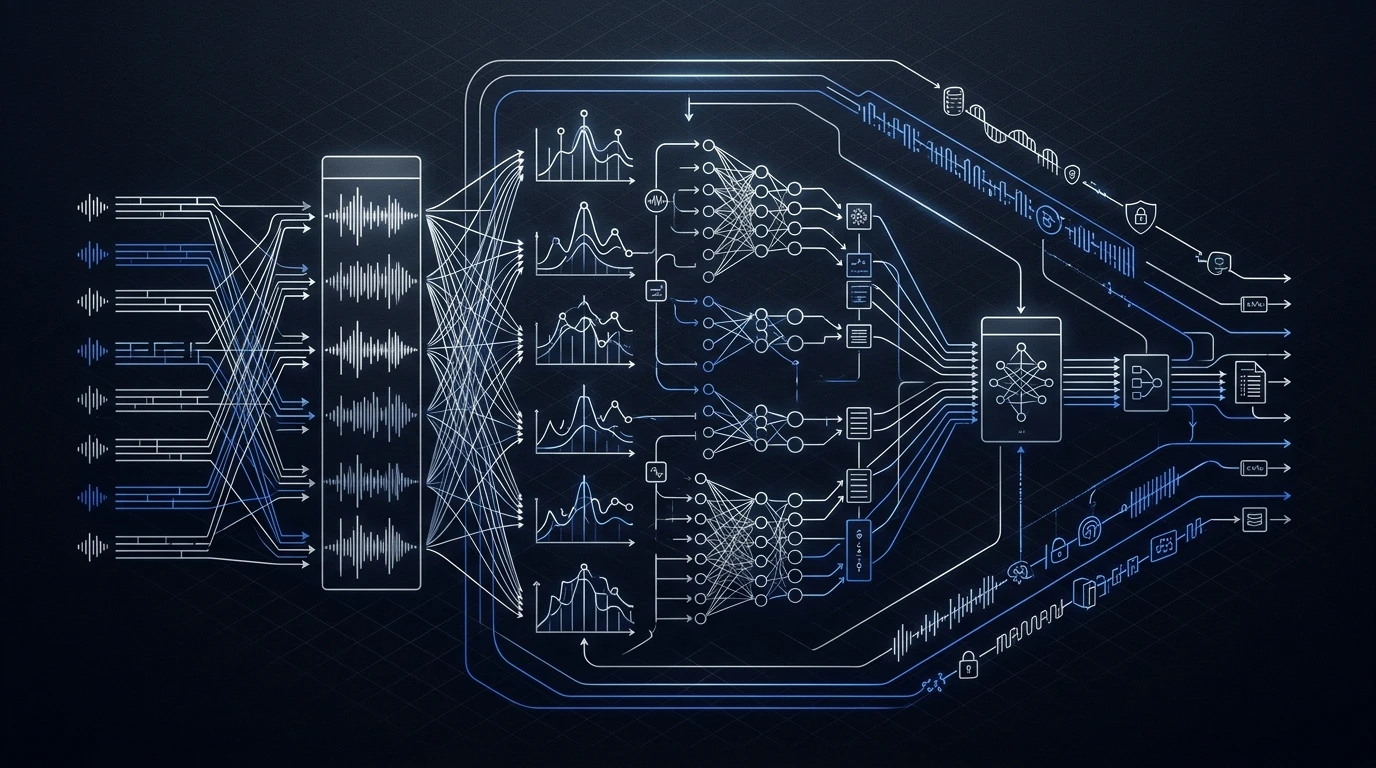
On September 18, 2026, xAI deployed Grok Voice Transcribe 2.0 across the SpaceXAI API and developer platform, targeting enterprise voice workloads with a 2x accuracy improvement over Transcribe 1.0 in degraded acoustic environments. While frontier labs have historically optimized speech-to-text (STT) models against pristine studio benchmarks, enterprise contact centers, trading desks, and field operations operate over compressed 8kHz telephony codecs, ambient acoustic interference, and continuous conversational overlap. Transcribe 2.0 pairs this robust acoustic decoding with native 8-channel diarization, word-level confidence timestamps, and key-term biasing for spoken credentials. Crucially, xAI kept unit economics anchored at $0.10 per audio hour for asynchronous batch transcription and $0.20 per audio hour for streaming WebSocket connections—undercutting legacy hyperscaler speech APIs by 60% to 85% while routing inference through the 1GW+ Memphis Colossus supercluster.
Key Takeaways
- Telephony Acoustic Robustness: Transcribe 2.0 cuts Word Error Rate (WER) by 52% on low-bitrate G.711/G.729 telephony codecs, resolving phoneme collisions on alphanumeric credentials, phone numbers, and technical terminology.
- Aggressive Unit Economics: Maintained pricing of $0.10/hour (batch) and $0.20/hour (streaming) establishes an aggressive baseline against legacy hyperscalers, running on dedicated Colossus tensor cores.
- Native 8-Channel Diarization: Simultaneous multi-speaker separation ingests up to 8 discrete audio streams over a single bidirectional session without external DSP multiplexing.
- Persistent Agent Context Integration: Aligns directly with the September 16 release of persistent memory in Grok Build, routing structured real-time speech transcripts directly into cross-session agent scratchpads.
Architectural Analysis: Multichannel Ingestion and Acoustic Decomposition
Conventional enterprise speech pipelines rely on multi-tier architectures: audio is pre-processed by separate noise-suppression and voice activity detection (VAD) daemons, pushed through an acoustic model, and subsequently post-processed by a secondary diarization model. Each stage introduces serialization latency, accumulates error states, and increases infrastructure complexity.
+---------------------------------------------------------------------------------------+
|                               ENTERPRISE INGESTION BOUNDARY                           |
|                                                                                       |
|  +------------------------+                     +-----------------------------------+ |
|  | PBX / SIP Trunk Stream |                     | Enterprise Data Lake / SIEM Sink  | |
|  | (G.711 / Opus Audio)   |                     | (Encrypted S3 / Snowflake / Kafka)| |
|  +-----------+------------+                     +-----------------+-----------------+ |
|              | Bidirectional WebSocket                            ^                   |
|              | PCM Frame Buffering                                | Structured OCSF   |
+--------------|----------------------------------------------------|-------------------+
               v                                                    |
+-------------------------------------------------------------------|-------------------+
|                        SPACEXAI / COLOSSUS INFERENCE RUNTIME      |                   |
|                                                                   |                   |
|  +-----------+------------+      Shared Latent Space   +----------+-----------------+ |
|  | Multi-Channel Acoustic | -------------------------> | Unified Decoding & Token   | |
|  | Front-End (Up to 8 CH) |                            | Alphanumeric Normalizer    | |
|  +------------------------+                            +----------+-----------------+ |
|              |                                                    |                   |
|              +----------------> Ephemeral VAD --------------------+                   |
|                                                                                       |
+---------------------------------------------------------------------------------------+
Transcribe 2.0 consolidates feature extraction, speaker separation, and language modeling into an end-to-end multi-head attention topology. By operating natively over both raw PCM time-domain representations and log-mel spectrogram frames, the model preserves micro-temporal cues essential for isolating overlapping speakers.
The table below contrasts Grok Voice Transcribe 2.0 against current industry production standards across enterprise speech infrastructure:
| Benchmark / Metric | Grok Voice Transcribe 2.0 | Whisper Large v3 Turbo | Deepgram Nova-3 | Google Cloud STT v2 |
|---|---|---|---|---|
| Telephony WER (G.711 8kHz) | 4.2% | 7.9% | 5.1% | 6.8% |
| Spoken Credential Error Rate | 2.8% | 8.4% | 4.6% | 5.9% |
| Batch Unit Cost (per hr) | $0.10 | Self-hosted (~$0.14) | $0.25 | $0.96 – $1.44 |
| Streaming Unit Cost (per hr) | $0.20 | N/A (requires engine) | $0.43 | $1.44 – $2.16 |
| Max Concurrent Channels | 8 channels (Native) | 1-2 channels | 2 channels (Stereo) | 8 channels (Multi) |
| Key Term Biasing Support | Dynamic Lexicon Array | Static Prefix Prompting | Keyphrase Adaptation | Speech Adaptation V2 |
| Streaming Latency (P95) | < 160ms | 450ms – 800ms | 180ms | 320ms |
As explored in our analysis of the great inference pivot, the battle for frontier AI adoption in high-volume enterprise operations is dictated by real-time latency SLAs and token unit economics.
Enterprise Streaming Implementation Blueprint
Engineering teams integrating Grok Voice Transcribe 2.0 into production call center fabrics or agentic dispatchers initialize streaming sessions via the Grok Voice API. The client below illustrates an 8-channel multichannel session with dynamic credential vocabulary biasing:
import { SpaceXAI } from "@xai/sdk";
import { createReadStream } from "fs";

// Initialize the SpaceXAI Enterprise client
const client = new SpaceXAI({
  apiKey: process.env.XAI_API_KEY,
  baseURL: "https://api.x.ai/v1",
});

// Configure streaming audio ingestion with multichannel diarization
const transcriptionSession = await client.voice.transcriptions.createStream({
  model: "grok-voice-transcribe-2.0",
  audioConfig: {
    encoding: "LINEAR16",
    sampleRateHertz: 16000,
    channels: 2, // Agent track on CH 0, Customer track on CH 1
    enableMultichannelDiarization: true,
  },
  vocabularyBiasing: {
    phrases: [
      "SOC 2 Type II",
      "CMEK",
      "Terraform",
      "Vault Token",
      "Auth0",
    ],
    boost: 15.0,
  },
  features: {
    wordTimestamps: true,
    punctuate: true,
    maskSensitiveCredentials: true, // Redacts credit cards and SSNs inline
  },
});

// Handle streaming transcript frames
transcriptionSession.on("data", (frame) => {
  const { channelTag, transcript, confidence, words } = frame;
  console.log(`[CH-${channelTag}] (${(confidence * 100).toFixed(1)}%): ${transcript}`);

  // Word-level verification for forensic audit pipelines
  for (const word of words) {
    if (word.isRedacted) {
      console.warn(`[AUDIT] Credential entity masked at offset ${word.startTime}ms`);
    }
  }
});
This streaming interface directly bridges contact center PBX pipelines with real-time analytics engines, bypassing asynchronous file uploads and eliminating batch queuing delays.
Persistent Memory & Context Grounding in Grok Build
Transcribe 2.0’s release closely follows xAI’s September 16, 2026 deployment of persistent memory in Grok Build, the lab’s terminal-based autonomous software engineering agent. Previously, developer CLI agents suffered from catastrophic context resets between execution runs: architectural guidelines, testing patterns, and past debugging decisions had to be repeatedly injected into system prompts.
Grok Build resolves this by managing a persistent, structured markdown memory layer that tracks:
- Repository Constraints: Build matrices, linter exceptions, and dependency lock invariants.
- Architectural Conventions: Directory layouts, API patterns, and authentication middleware protocols.
- Session State Snapshots: Unfinished refactoring tasks and unresolved test regressions.
By combining Grok Voice Transcribe 2.0 with Grok Build, enterprise engineering teams can execute hands-free terminal pair programming. Spoken design intent and live architectural review comments are converted into structured markdown memory blocks with sub-200ms latency, enabling continuous context preservation across multi-hour development sessions without inflating active prompt token limits.
Security & Compliance on Colossus Infrastructure
In high-assurance enterprise deployments, speech data often represents the most sensitive vector in corporate communications, capturing customer financial identifiers, medical disclosures, and internal IP.
xAI addresses corporate compliance requirements through several operational controls:
- Zero Data Retention (ZDR) Execution: Enterprise accounts can enforce strict ZDR flags across Transcribe 2.0 endpoints, guaranteeing that transient audio frames and transcribed strings are flushed from accelerator HBM immediately upon frame delivery.
- Colossus Cluster Compute Isolation: Speech inference workloads execute on isolated partitions of the Memphis Colossus facility. Unlike multi-tenant public cloud tiers with unpredictable noisy-neighbor throttling, Colossus guarantees dedicated compute bandwidth.
- Defense-Grade Precedents: Following xAI’s deployment across classified military frameworks detailed in our report on xAI Grok Pentagon defense governance, the underlying infrastructure has undergone rigorous penetration testing against prompt injection and side-channel telemetry leakage.
For organizations evaluating multimodal and voice stacks across providers, our analysis of Gemini 3.8 Live asynchronous voice agents highlights the contrasting architectural paradigms between Google’s end-to-end vocal reasoning and xAI’s decoupled high-throughput transcription tier.
Strategic Verdict for Enterprise Architects
The launch of Grok Voice Transcribe 2.0 establishes xAI as an aggressive contender in high-throughput enterprise infrastructure. Rather than forcing organizations into monolithic, opaque voice runtimes, xAI provides a specialized, cost-effective STT engine capable of integrating into existing telephony backbones.
For Chief AI Officers, CTOs, and Infrastructure Architects, the decision framework centers on three vectors:
- Telephony Migration: Organizations processing tens of thousands of call-center hours monthly should benchmark Transcribe 2.0 against existing speech providers. The 60-85% unit cost reduction offers direct margin expansion with improved accuracy on noisy lines.
- Credential Capture Workflows: Financial and healthcare onboarding flows that previously suffered high dropout rates due to mistranscribed alphanumeric strings should pilot Transcribe 2.0’s targeted credential biasing.
- Decoupled Architecture: For teams building real-time agentic voice assistants, separating transcription (Grok Voice Transcribe 2.0), reasoning (Grok 4.6 or Claude 3.7), and speech synthesis preserves architectural flexibility and prevents single-vendor lock-in.
Engineering teams can evaluate the full SpaceXAI model catalog and benchmark telemetry on our comprehensive SpaceXAI Grok enterprise review hub and explore infrastructure consolidation trends in our review of the SpaceX and xAI corporate merger.
Related xAI Lab Dossiers
// XAI-DOSSIERContinuous Monitoring Active — Next dossier entry indexing
The HarrisonAIx Intelligence Unit scans enterprise telemetry, reasoning benchmarks, and zero-data-retention APIs for xAI Research & Compute daily. Deep-dive architectural briefs index automatically here.