Spatial Intelligence: The Next AI Frontier for Enterprise


The race for artificial general intelligence (AGI) is no longer confined to chatbots and text constraints; we are rapidly entering an era where AI must fundamentally understand and navigate the 3D physical world.
Key Takeaways
- The Missing Half of Intelligence: While Large Language Models (LLMs) mastered linguistic communication, spatial intelligence is required for AI to interact meaningfully with the real world.
- From ImageNet to World Models: Fei-Fei Li’s visionary leadership is shifting the paradigm from understanding 2D pixels to building complex 3D world models.
- Unlocking Enterprise Potential: Spatial intelligence opens doors for significant breakthroughs in robotics, manufacturing, and immersive digital environments.
The Evolution of “Doing” over “Saying”
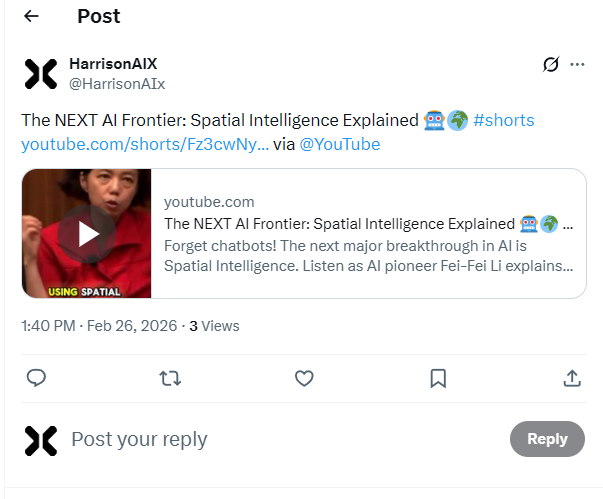
In a recent Possible Podcast episode, Dr. Fei-Fei Li, renowned as the “Godmother of AI,” articulated a profound limitation of current language models: they only represent half of what constitutes human intelligence. We use linguistic communication to talk and organize our knowledge. But the other half—the deeply profound aspect—boils down to what we do.
Whether navigating a crowded room, cooking a meal, or operating heavy machinery, human intelligence relies on an innate ability to perceive and act within a 3D space. This critical capability, termed spatial intelligence, is the foundational native ability required to transition AI from mere conversational agents to active participants in our physical and digital reality.
For leaders exploring the Physical AI in the enterprise revolution, this represents a paradigm shift from passive software to active, embodied enterprise solutions.
World Labs and Large World Models
Li’s new startup, World Labs, is leading the charge to solve this challenge. Having recently attracted over $1 billion in funding according to industry reports via Silicon Republic, World Labs is building “large world models.” These frontier models aim to perceive, generate, reason, and interact with the 3D world.
Unlike 2D generation that relies on projecting flat pixels—a legacy dating back to Li’s groundbreaking ImageNet project over 15 years ago—world models actually simulate physics, geometry, and depth. This level of simulation is non-negotiable for enabling AI to act reliably inside our physical environments. It’s the unifying technology that will eventually drive enterprise digital twins, allowing for seamless interoperability between physical operations and digital simulation models.
Implications for the Modern Enterprise
Why does spatial intelligence matter for your business? Today, AI acts as an invisible advisor. Tomorrow, equipped with spatial intelligence, AI will become an active participant in environments spanning manufacturing floors to architectural design.
As we bridge the gap between digital ideation and physical execution, systems capable of 3D reasoning will drastically reduce errors and accelerate the deployment of autonomous systems in real-world settings.
Next Steps
To prepare for the integration of spatial intelligence:
- Evaluate bottlenecks: Look for areas in your physical operations where 2D machine vision has fallen short due to spatial complexity.
- Pilot advanced simulations: Begin experimenting with digital twins and 3D environment generation for training software models.
- Stay informed: Keep a close eye on early commercial viability of large world models released over the coming year.
Spatial intelligence isn’t just an academic milestone; it’s the operational nervous system for the next generation of enterprise AI.