OpenClaw Ordering Frenzy Creates Global Apple Mac Shortage


The barrier to entry for personal, highly capable AI is dissolving, and the hardware supply chain is straining under the shift. As developers and businesses realize the power of running 70-billion parameter models locally, a massive run on high-unified-memory Apple machines has begun.
Key Takeaways
- Agentic AI Drives Hardware Demand: The rise of “world’s first true AI agent” OpenClaw (formerly Moltbot) is causing a run on Mac Studio and Mac Mini inventory.
- Unified Memory Advantage: Apple’s Unified Memory architecture bypasses typical PCIe bottlenecks, making it the premier choice for running massive LLMs locally.
- Six-Week Lead Times: Wait times for high-end Apple hardware now range from six days to an astonishing six weeks according to recent reporting.
The PCIe Bottleneck and the Apple Advantage
While cloud hyperscalers hoard enterprise GPUs, developers building personal AI agents face a different set of challenges. As Tom’s Hardware reports, running a massive 70-billion parameter model in FP16 requires approximately 140GB of memory just for the weights.
Even if you string together five high-end consumer GPUs, you are limited by PCIe bandwidth. That’s where Apple’s localized Unified Memory excels. Because the CPU, GPU, and NPU all share the same memory pool, developers can build potent local AI rigs without requiring expensive NVLink setups. It’s the ultimate enabler for systems like Moltworker, ensuring privacy and blistering inference speeds right on your desk.
The OpenClaw Effect
The catalyst for this sudden hardware drought is the viral explosion of OpenClaw. Recognized by many as the first true functional AI agent, OpenClaw thrives on the high-memory environments that Apple Silicon so elegantly provides.
The industry response has been immediate. Peter Steinberger, creator of OpenClaw, commented on the rapid sellouts:
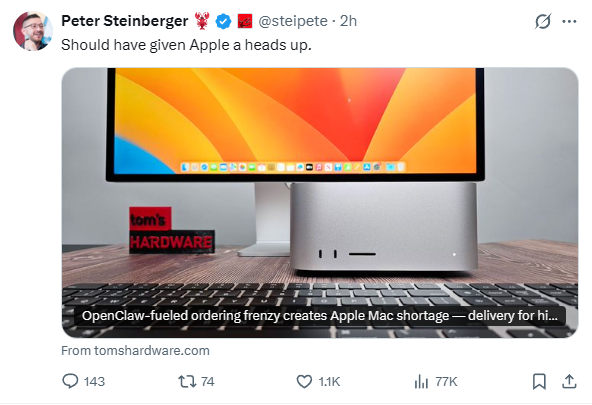
What used to be a 14-day wait for a Mac Studio configuration has ballooned to 54 days in some areas. The implications for business are profound; as we predicted in our piece on the AI Agents New Workforce, possessing local, autonomous compute is transitioning from a luxury to a critical competitive requirement. The scramble for Mac hardware is simply the physical symptom of a major software paradigm shift.
Final Thoughts
The OpenClaw-fueled Apple Silicon shortage isn’t just a supply chain hiccup; it’s a permanent shift in how computing resources will be allocated going forward. As models grow and the demand for autonomous, private agents escalates, securing the right on-premise hardware strategy will be as vital as optimizing your cloud architecture.